

Description
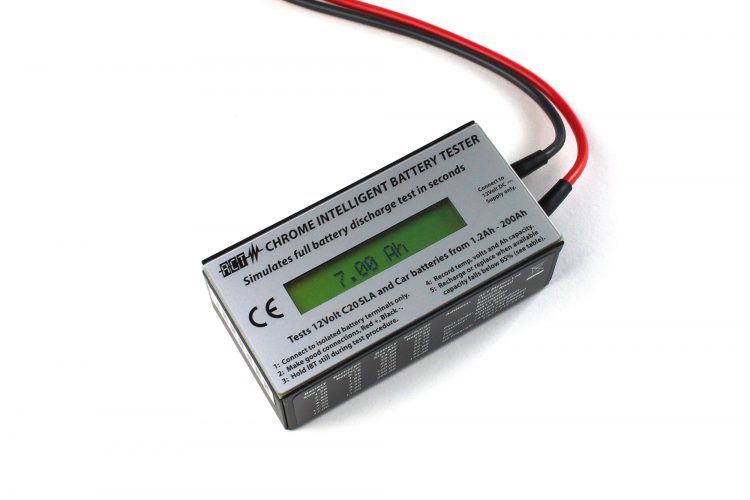
ACT/Chrome Intelligent Battery Capacity Tester
The tester features built-in temperature compensation, allowing accurate measurement of the battery’s actual usable capacity.
-
Compact design and easy operation.
-
Simulates a 20-hour (C20) discharge test in seconds
-
Designed for 12 V standby lead-acid (SLA) batteries in the range of 1.2 Ah to 200 Ah
-
Temperature compensation included
-
Automatically displays DC voltage and available amp-hour (Ah) capacity based on battery temperature and state of charge
-
Quickly checks voltage and capacity of new, out-of-the-box batteries
-
Detects low or abnormal capacity in used batteries
-
Reverse polarity protection included
-
Powered directly from the tested battery
-
No complex setup required
Fast detection
The ACT CHROME 12V SLA battery tester uses advanced pulse load technology to provide accurate results for DC voltage and Ah capacity, taking into account temperature and charge level. A quick reference chart on the device indicates when batteries should be recharged or replaced (if capacity drops below 65% of rated value). A built-in temperature-sensitive strip also records ambient temperature.
Included in the package:
-
ACT CHROME 12V SLA Intelligent Battery Tester
-
ACT 3532 clamps
-
ACT 410N soft carrying case
-
Sample ACT BTL labels
-
User Manual
-
Calibration certificate
Quick tips – Temperature effect on capacity:
-
Most high-quality battery manufacturers specify the battery’s nominal capacity at a temperature of 20°C.
-
Below 20°C, the actual capacity of the battery can significantly decrease.
-
Above 20°C, the battery capacity can significantly increase.
-
The difference can be up to ±50% of the nominal value at 20°C.
-
When testing, take into account the effect of ambient temperature—for example, in an equipment cabinet or near a hot transformer the result may be higher, while in a cold environment it may be lower.
-
The ACT CHROME tester has built-in temperature compensation to perform testing in accordance with NFPA 72 requirements.
Quick tip – effect of state of charge on capacity
-
Most manufacturers specify battery capacity under resting conditions.
-
Charging voltage and current directly affect the available capacity.
-
Take into account during testing if the battery has been recently disconnected from charging.
-
Many new batteries are not fully charged after manufacturing.
Quick tip – effect of connections on test results
-
Always connect to clean battery terminals.
-
A secure and tight connection at the terminals is a prerequisite for accurate results.
-
Do not connect to high-resistance bolts — this causes low Ah readings
-
If bolt connections are used, use the included ACT 3532 battery terminal connectors.
Technical Specifications
| Spetsification | Details |
|---|---|
| Operating power | 12 VDC |
| Polarity protection | Diode |
| Battery types | 12V SLA (sealed lead-acid batteries) |
| Battery capacity range | 1.2Ah – 200Ah |
| Ah capacity test | Simulated 20-hour (C20) load test down to 10.50 VDC. |
| Ah result determination | Based on the temperature of the tested battery and its state of charge. |
| Battery indicator / table | Charge or replace the battery if the available capacity drops below 65% of the battery’s rated capacity. |
| Display type | Green backlit LCD display |
| Low battery warning | <10,50 VDC |
| Repeated testing | Maximum of 5 test cycles within 30 minutes; protection against overheating. |
| DC voltage accuracy (DCV) | ±5% of the displayed value. |
| Amp-hour (Ah) accuracy | ±10% – for fully charged, high-quality C20-rated SLA batteries at a temperature of 20–25°C (68–77°F). |
| Housing material | Metal / plastic |
| Dimensions | 55 (H) × 100 (W) × 35 (D) mm |
| Warranty | 12 months |
| Included in the package | ACT Chrome Intelligent Battery Tester, ACT 3532 terminal connectors, ACT 410N soft carrying case, sample ACT BTL labels, user manual, and calibration certificate. |